top of page
Girish Suryajoies
Principal UX Designer

Ticket Management

role: Senior Design Consultant
team: 1
responsibility: Design & Strategy
duration: 2 Months
Introduction
CBRE Group, Inc. is the world’s largest commercial real estate services and investment firm, providing comprehensive services such as investment, leasing, property management, valuation, and development. As part of its operational workflow, CBRE handles over 10,000 administrative requests annually through multiple email inboxes, posing challenges in process efficiency and request tracking.
Requirement
-
Non-standardized input formats leading to inconsistent data capture.
-
Inefficient workflows heavily reliant on manual email communication and manual processing.
-
Limited visibility for both requestors and management teams regarding request volumes, statuses, and response times.
CBRE faces significant hurdles in managing a high volume of administrative requests across five email boxes. Key issues include:
User
-
CBRE CMMS (Computerized Maintenance Management System) Team: Responsible for managing and acting on administrative requests.
-
CBRE Approvers: Individuals who review, approve, or escalate requests as part of the workflow process.
Goal
-
Standardizes request intake to ensure consistent data capture and validation.
-
Automates workflows to reduce manual processing and email dependency.
-
Provides clear, real-time visibility of request status, volume, and response metrics to both requestors and management.
-
Enhances user experience for CMMS team and approvers, enabling faster decision-making and response.
Decision Design
-
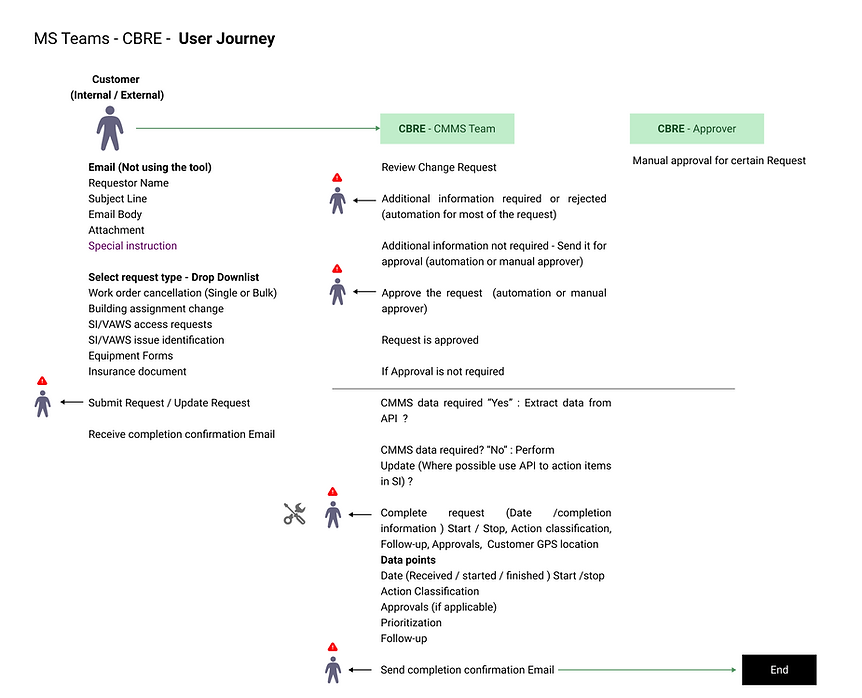
Centralized Request Portal: Develop a unified interface (web or app-based) where requestors can submit standardized administrative requests instead of using emails. This portal would enforce input validation and required fields to reduce errors and ambiguity.
-
Workflow Automation: Automate task assignment and routing based on request type and approver availability, reducing manual forwarding and follow-up. Notifications and reminders can be integrated for timely responses.
-
Dashboard & Reporting: Provide real-time dashboards for both requestors and management to track requests by status, volume, average response time, and bottlenecks, enhancing transparency and operational insight.
-
Integration with PowerApps: Leverage existing PowerApps infrastructure to feed data into the new system for monitoring and management continuity, ensuring seamless transition and data coherence.




Value additions
-
AI-Powered Request Parsing and Classification: Use natural language processing (NLP) to analyze incoming requests (especially legacy emails) and automatically classify, extract key information, and populate structured fields in the system, reducing manual data entry.
-
Intelligent Workflow Management: Implement AI-driven decision support to prioritize requests based on urgency, complexity, or historical response time patterns, optimizing resource allocation and speeding approvals.
-
Automated Response Generation: Enable AI chatbots or virtual assistants to handle common queries or provide request status updates to requestors instantly, reducing workload on the CMMS team.
-
Predictive Analytics: Utilize AI to forecast workload trends and potential delays, allowing preemptive adjustments and resource planning to maintain service levels.
-
Sentiment Analysis: Analyze request content for urgency or tone to flag critical issues requiring immediate attention.
bottom of page